
Health Library / Longevity tech
This content is for education only and is not medical advice. I'm a fitness coach, not a physician. Talk to your doctor before starting any medication, hormone, supplement, or new exercise program, especially if you have a medical condition or take prescriptions.
This is the part of the longevity industry I'm most enthusiastic about, and it's the part people skip because it isn't as fun as a cryo chamber.
Measurement is the highest-value thing on the menu. You can't manage what you don't measure, and most people over 45 are running on a weight from the bathroom scale and a cholesterol number they half remember.
Here's what's available, what it tells you, and what it doesn't.
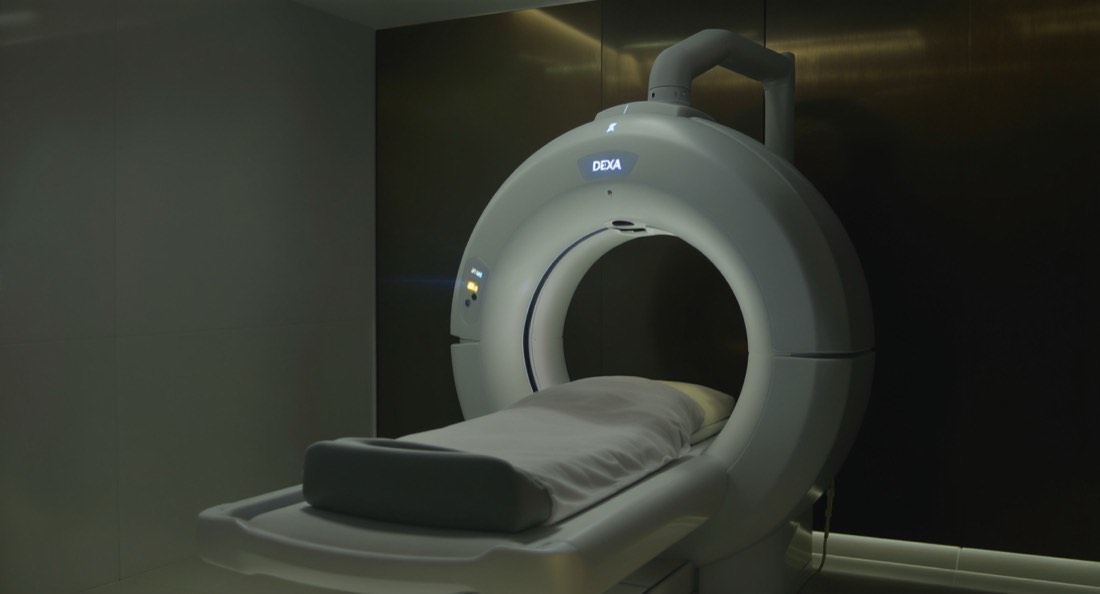
A low-dose X-ray scan, about ten to fifteen minutes, that gives you three things: bone density, lean mass, and fat mass including where it sits — notably visceral fat, the metabolically dangerous kind packed around your organs.
This is the gold standard for body composition and it's the single most useful scan for anyone over 45 who lifts. It settles arguments the scale can't: are you actually losing fat or losing muscle? Is your bone density where it should be, particularly for women post-menopause?
Austin has several places doing this — DexaFit up in Round Rock, Live Lean Rx, PURE Body Lab — typically a short appointment with results discussed on the spot. Prices generally run in the low hundreds, less in packages.
Get a baseline and repeat it in six to twelve months. A single scan is interesting; two scans tell you whether what you're doing is working. If you're on a GLP-1, this is the test that tells you whether you're losing the right tissue, and I'd call it close to essential.
You wear a mask on a treadmill or bike while the intensity climbs, and a machine measures the oxygen you consume and the CO₂ you produce until you can't continue.
You get your actual VO2 max rather than a watch's estimate, plus your true training zones — which is the practical payoff, because most people's Zone 2 guess is wrong and usually too hard. Often bundled with RMR, resting metabolic rate, measuring what you burn at rest.
Cardiorespiratory fitness tracks with long-term health outcomes about as well as anything we measure, so having the real number is worth something, and retesting shows whether your training is actually moving it.
It's uncomfortable. It's supposed to be — the test ends when you're done.
Covered properly in the labs module. The short version for this context: the comprehensive panels these clinics sell typically include things a standard physical skips — ApoB, fasting insulin, a fuller thyroid picture, inflammatory markers, hormones.
That's genuinely useful. Two cautions. More markers means more things slightly out of range, and a normal person will always have a few, which can start a chase that costs money and worry. And some clinics sell you the panel and then sell you the treatment for what they found, which is a business model with an obvious incentive built into it.
Electrodes on your scalp measuring electrical activity, producing a map of brain wave patterns. Ways2Well's Austin lab offers it as a "snapshot of brain performance" used to personalize protocols.
It's a real technique with established clinical uses, particularly in epilepsy. As a wellness tool for optimizing a healthy person's brain, the evidence is much thinner, and what any given pattern means for someone without a diagnosis is not well established. Interesting; not decisive.
The big-ticket item — an hour in a scanner, no radiation, looking for anything abnormal anywhere. Marketed hard as catching cancer early.
Here's the balanced version, because this one has a genuine debate behind it.
The case for: it occasionally finds something serious, early, in someone with no symptoms. When that happens it's life-changing and no argument survives contact with it.
The case against: scanning healthy people finds a lot of incidental findings — spots, cysts, nodules that were never going to hurt you. Most turn out to be nothing, but you don't know that at the time, so you get follow-up scans, sometimes biopsies, with their own risks, plus months of fear. Major medical bodies have generally not endorsed whole-body screening of asymptomatic people for this reason.
If you're drawn to it, go in understanding that a finding is common and usually benign, and know who's going to help you interpret it.
Spit or blood, back comes a number: you're 47 but your biological age is 41. Enormously appealing and worth understanding before you buy.
These read chemical marks on your DNA — methylation patterns — that change with age in predictable ways. The underlying science is real and it's a serious research field.
The consumer product is shakier. Different clocks give different answers for the same person. Test-retest reliability is a known problem — the same sample can come back meaningfully different. And nobody has shown that watching this number and acting on it improves anything, because that study would take decades.
Fun. Motivating, if a lower number keeps you training. Not a fact about your body in the way a DEXA scan is.
Covered in the metabolic module. Short version: a genuinely good learning tool for a month, because watching your own breakfast move your own glucose teaches more than any article. Weak evidence for long-term use in people without diabetes, and I've seen it drive anxious eating.
The most underrated item on this entire list. Home sleep apnea tests are now straightforward — a device you wear for a night.
If you snore and you're tired during the day, this is more valuable than every scan above combined. Sleep apnea is common over 45, badly underdiagnosed, and treating it changes people's lives in a way no drip ever has.
If someone gave you a thousand dollars for diagnostics:
Comprehensive blood panel with the markers your physical skips.
DEXA scan for a baseline. Sleep study if there's any hint of apnea.
VO2 max if you're training seriously and want real zones.
That's a genuinely informative afternoon and it'll shape the next two years.
Then the part people skip: take the results to a physician who knows you. I can tell you what these tests measure. I can't tell you what yours mean, and the clinic that sold you the panel has an interest in what it found.
These are listed for reference, not as recommendations. Ockerman Health has no financial relationship with any provider listed here, receives nothing for these links, and does not endorse, vouch for or verify any of them. They appear because they publicly advertise the services this article explains, so you can see for yourself what's being offered and what it costs. Anything on this list is between you and them — and anything medical is between you and your doctor.
Last updated September 30, 2026