
Health Library / Hormones
This content is for education only and is not medical advice. I'm a fitness coach, not a physician. Talk to your doctor before starting any medication, hormone, supplement, or new exercise program, especially if you have a medical condition or take prescriptions.
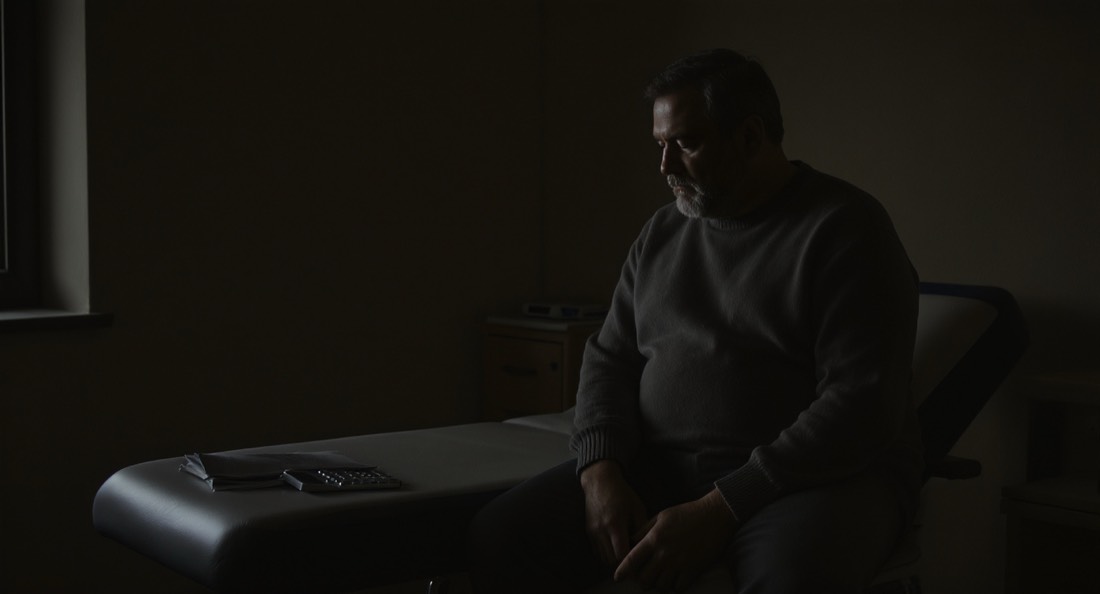
The ad finds you somewhere around your second bad month. Tired, thick around the middle, nothing in the tank. The ad says you might have Low T, and there's a clinic twenty minutes away, and they can see you Thursday.
I'm not going to tell you low testosterone isn't real, because it is, and for the men who genuinely have it, treatment can be the thing that gives them their life back. What I want is for you to walk in there knowing what you're walking into, because a lot of men don't, and it's a bigger decision than the ad makes it sound.
Not off a symptom quiz. Not off one blood draw.
Testosterone runs on a daily cycle and it's highest in the morning, so the standard is a blood test taken early, and then a second one on a different day to confirm it. One low reading in the afternoon after a bad week of sleep is not a diagnosis. It's a reason to test properly.
A physician is also going to want to know why it's low, because that changes what should happen next. Low testosterone can be a signal pointing at something else entirely, and skipping the "why" to get straight to the treatment is how real problems get missed.
If a place is ready to prescribe off one number and a questionnaire, that tells you what kind of place it is.
Before I talk about treatment, I have to be straight with you about this part, because it's unglamorous and it works.
Sleep. Short sleep drops daytime testosterone measurably in young healthy men within about a week. That's a controlled study, not a theory. If you're running on five hours, you don't have a clean baseline to test against.
Body fat, particularly around the middle. Fat tissue is metabolically active and it participates in your hormone picture. Losing meaningful weight raises testosterone in men who are carrying a lot of it.
Strength training. Not because a session gives you a lasting hormone spike — that effect is small and short. Because it changes body composition and insulin sensitivity over months, and those are the levers.
Alcohol. Heavy, regular drinking works against you here in several directions at once.
None of that is a cure and I'm not claiming it is. Some men do all four correctly and are still low, and those men need a doctor. But if you haven't touched any of them, you don't yet know what your number would be if you did.
This is the part the ad leaves out. If you start testosterone therapy for genuine deficiency, you are generally starting something long term — in many cases indefinitely. Your body reduces its own production while you're on it, so stopping isn't a clean exit.
Three things get monitored, and there's a reason for each:
Fertility. Testosterone therapy suppresses sperm production. If having children is on the table at all, say so out loud at the first appointment, before anything starts. There are paths that account for this, and they're much easier to plan than to reverse.
Red blood cell count. Therapy can drive your hematocrit up, which thickens the blood. That's why bloodwork keeps happening, not just at the start.
Prostate. Monitored as part of standard care.
That's not a scare list. Those are the normal, expected checkpoints of a supervised treatment, and the fact that they exist is exactly why this belongs with a physician who's following you over time rather than a shop that sees you once a quarter.
Who reads my labs, and how often will they be redrawn. What's the plan if my hematocrit climbs. How does this affect fertility in my case specifically. What happens if I want to stop in two years. And who do I call on a Tuesday when something feels off.
If those answers are thin, keep shopping. Hormone therapy done well is medicine. Done casually, it's a subscription.
Last updated September 30, 2026