
Health Library / Training
This content is for education only and is not medical advice. I'm a fitness coach, not a physician. Talk to your doctor before starting any medication, hormone, supplement, or new exercise program, especially if you have a medical condition or take prescriptions.
A hip fracture at 75 is not a broken bone. It's a life event. A large share of people who break a hip never get back to living the way they did before it, and the mortality figures in the year that follows are grim enough that I'm not going to quote them at you in a fitness article.
I'm telling you this because the decisions that determine how that goes get made twenty-five years earlier, and they get made in a gym.
Bone is living tissue. It's constantly being broken down and rebuilt, and the balance between those two shifts against you with age.
For women it's not a gentle shift. Estrogen restrains the cells that break bone down, so when estrogen drops at menopause, that brake comes off. The first several years after your last period are the fastest bone loss of your life. A woman can lose a substantial fraction of her bone density in that window, and nothing about it hurts or shows up in a mirror.
Men lose bone too, slower and later, and men are underdiagnosed for exactly that reason — osteoporosis gets treated as a women's condition, so men often find out when something breaks.
The first symptom of osteoporosis is frequently a fracture. That's the whole problem with it.
Here's the part that should change how you train.
Bone adapts to the forces put through it. Put meaningful load through a skeleton and it responds by getting denser where the load is. Take the load away and it gives the tissue back, because maintaining bone is expensive and your body doesn't fund things it isn't using. Astronauts lose bone dramatically in weightlessness. Bed rest does the same thing.
Two kinds of loading do this:
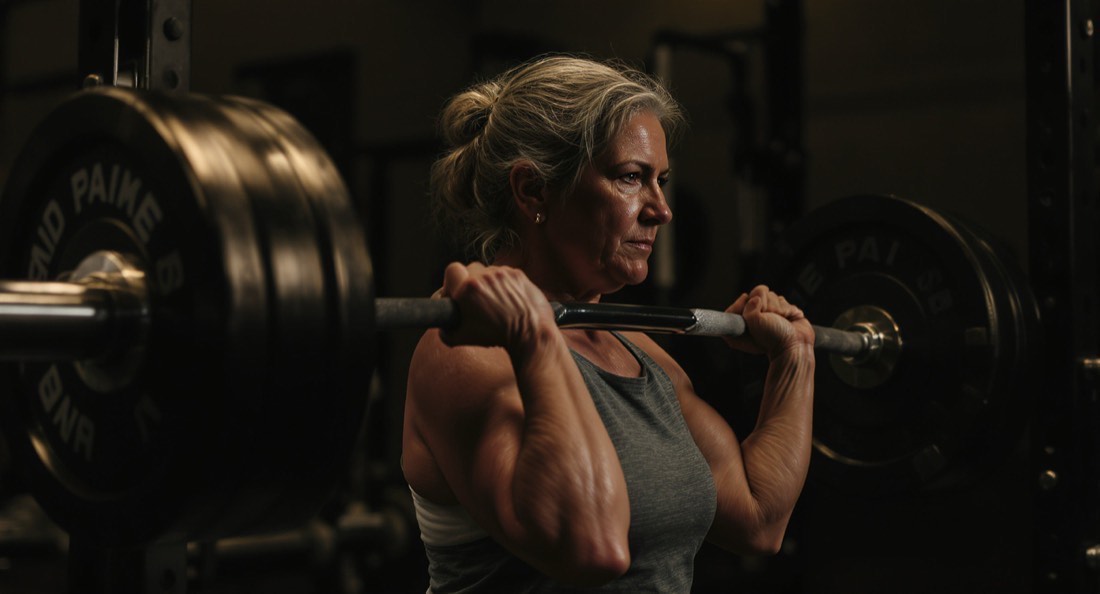
Heavy resistance training. Muscle pulling hard on bone is the signal. Note the word heavy — a weight you could lift thirty times isn't generating the force that triggers adaptation. This is the one people get wrong, because women in particular are steered toward light weights and high reps, which is close to the opposite of what bone needs.
Impact. Foot strike, jumping, hopping. Brief, sharp forces. Walking is excellent for many things but it's not much of a stimulus for bone — your skeleton is already comfortable with walking.
This has been tested directly in postmenopausal women with low bone mass, with supervised programs using genuinely heavy lifting and impact work, and it improved bone rather than merely slowing the loss. That result surprised people who assumed the best you could do was decelerate the decline.
Loading is the signal. Calcium and vitamin D are the materials. You need both halves — supplements alone, without loading, don't do much for bone, which is the quiet finding behind a lot of disappointing supplement trials.
Get calcium from food where you can. Vitamin D is worth testing, especially if you're indoors most of the day, and yes, people in Hawaii come back low — sunscreen, offices, and covering up all do what they're supposed to.
A DEXA scan measures bone density, takes minutes, and involves a trivial amount of radiation. It gives you a T-score comparing you to a healthy young adult. That number sorts you into normal, low bone mass, or osteoporosis.
Ask about it if you're a woman around or past menopause, a man over 65 or with risk factors, anyone who's broken a bone from a minor fall, or anyone with a family history or long-term steroid use. A baseline is worth having even if it's fine, because the trend over time tells you more than any single reading.
Then you need a modified program, and this is where I stop giving general advice.
Some movements that are fine for the rest of us carry real fracture risk with significantly weakened bone — particularly loaded bending and twisting of the spine. Certain common exercises are routinely avoided in this population for that reason.
If you've been diagnosed, work with someone qualified who knows your scan results — a physical therapist or an exercise professional experienced with bone disease, coordinating with your doctor. You should absolutely still train. Loading is still the answer. But which loading, and how it's introduced, needs to be built around your actual numbers, not an article.
The goal isn't to avoid stress on the skeleton. It's to apply the right kind in the right order.
Last updated September 30, 2026